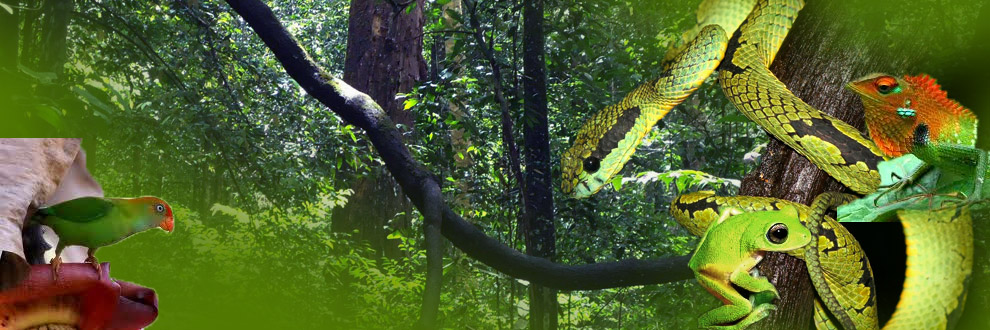
The rain forest is the habitat parexcellence for amphibians. It is not surprising therefore that half the total number of amphibian species in sri Lanka and nearly half the endemic amphibian are represented in Sinharaja. These amphibians are mainly frogs and toads and a single limbless form (Table 12).
 |
|
Wrinkled Frog (Rana corrugata) |
| |
|
|
 |
|
Greater Hourglass Tree Frog (Rhacophorus cruciger) |
| |
|
|
 |
|
Reed Frog (Rana greeni) |
| |
|
|
 |
|
Torrent Toad (Buffo kelaartii) |
Common Name |
Species Name |
| *Wrinkled Frog |
Rana corrugata |
| Sri Lanka Reed Frog |
Rana greeni |
| *Lesser Wood Frog |
Rana aurantiaca |
| *Slender Wood frog |
Rana gracilis |
| **Guenther's Cliff Frog |
Nannophrys guentheri |
| *Sharp nosed Tree Frog |
Rhacophorus nasutus |
| Small-eared Tree Frog |
Rhacophorus microtympanum |
| *Greater Hourglass Tree Frog |
Rhacophorus cruciger |
| *Wrinkled Tree Frog |
Philautus schmardanus |
| Variable Tree Frog |
Philautus variabilis |
| Lesser Sharp-nosed Tree Frog |
Philautus nasutus |
| *Red Ramanella |
Ramnella palmata |
| Common Toad |
Bufo melanostictus |
| *Torrent Toad |
Bufo kelaartii |
| *Yellow-banned Caecillian |
Ichthyophys glutinosus |
| *Endemic species |
**Endemic genera |
One of the commonest frogs in the forest is the Wrinkled Frog heard frequently from marshes and streams. Several species of tree frogs and the Reed frog while has a call similar to that of a bird can be heard distinctively at night.
The moist environment is conducive for the Sharp-nosed Tree Frog to lay its eggs in a nest of foam on the underside of Cardamom leaves overhanging a stream. This enables the young tadpoles to drop straight into the water when they hatch out. The Lesser Sharpnosed Tree Frog adopts a different strategy. It lays eggs on leaf little where rain water has accumulated. The life cycle is completed within the egg thereby avoiding a free swimming tadpole stage. Others such as Ramnella palmata live their whole life cycle in tree rot holes filled with rain water. The Guenther's Cliff Frog inhabits vertical rock faced covered with dripping water. the young tadpoles are adapted to living on the wet rock face. These strategies among the amphibia could only be possible in an ever-wet environment. The discovery of Guenther's Cliff Frog in 1982 is particularly significant because its sighting at Sinharaja is the first since the type specimen was collected in 1890.
The Yellow-banded Caecilian the only limbless amphibian recorded at Sinharaja, inhabits marshy edges and lives under the wet earth.
|