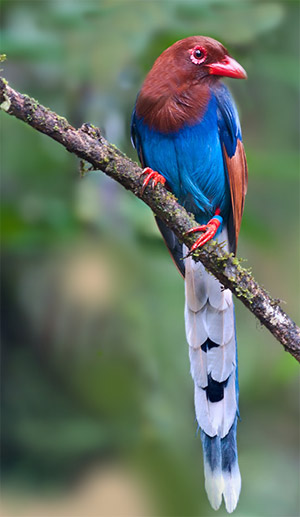
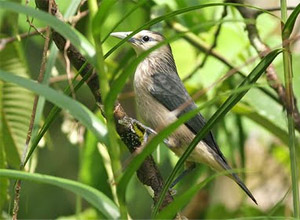
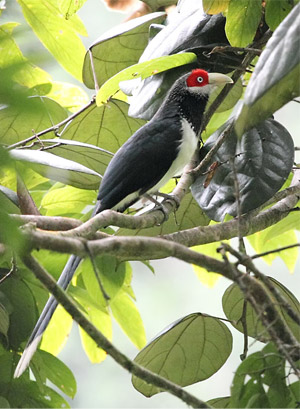
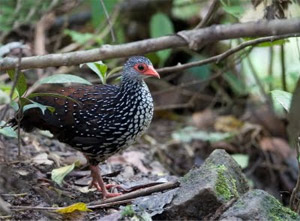
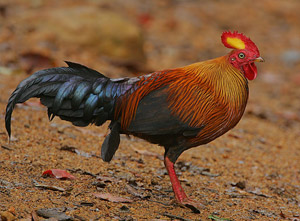
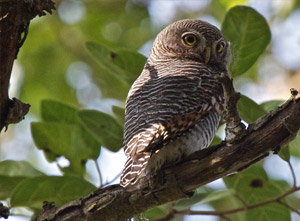
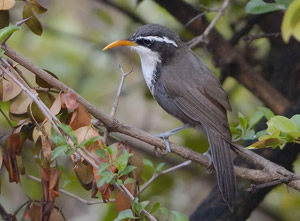
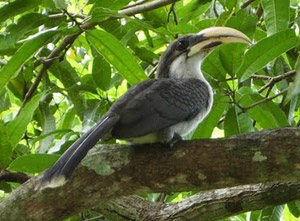
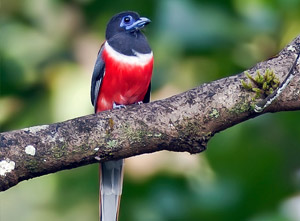
The Sinharaja Reserve is rich in bird life with an impressive 147 species recorded to date. It is also the only locality where 18 out of 20 birds species endemic to Sri Lanka may be viewed. Many of these endemic birds have been indicated in Table 10 and Figure 11. Interestingly, few endemic and other species thought to be confined to the hill-zone have also been sighted at Sinharaja viz. the White-eye, the Scaly Thrush(Zoothera dauma), the Wood Pigeon (Columba torrigtoni), the Dusky Blue Flycatcher(Muscicapa sordida) and the Yellow-eared Bulbul (Pycnonotus penicillatus). The wide variety of habitat-specific birds seen in Sinharaja is due to the continuous expanse of forest ranging from 300 to 1,500 meters, which provides the habitat of the forest is comparatively better studied than the other groups of animals. These studies include an inventory of the species; more detailed studies on population dynamics, feeding activity and other behavior patterns are currently in progress.
Among the birds recorded in the western sector of the Sinharaja, 13% were migrants. Of the resident species, 18% were confined to the heavily forested areas and 10% to village home-gardens and peripheral scrub areas. At least 36% of the species were common to the forest as well as to outside habitats. This is mainly due to the spread of secondary scrub areas into the forest particularly along logging roads. Data available indicates that most bird species are habitat sensitive and likely to be eliminated if forest areas are disturbed. 56% of the species are either rare or have low population densities. Of the 42% classified as common, a large proportion, 68% were confined to heavily forested undisturbed areas. Meanwhile, the International Council for Birds Preservation (ICBP) world list of threatened bird species for 1989, includes several species found at Sinharaja such as the Blue Magpie, the White-headed Starling, the Ashy-headed Babbler, the Green-billed Coucal, the Red-faced Malkoha, the Spotted-winged Thrush and the Wood Pigeon.
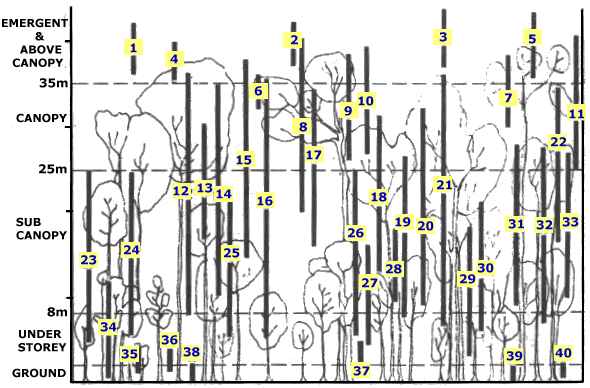
Mixed species bird flocks are one of the most interesting experiences of the forest. This peculiar aggregation of birds, is thought to be a strategy for improving feeding efficiency and protection against predators. Observations made on at least 100 such flock at Sinharaja, revel that over 40 species of birds, including 12 endemic species, participate in flocks (Table 10). Bird flocks shows a distribution pattern that corresponds closely with the stratified vegetation structure. Different groups of species occupy the forest floor, undergrowth, mid canopy and high canopy (Figure 11). Flocks are also regularly accompanied by animals such as the Giant Squirrel, the Jungle Squirrel, the Purple-faced Leaf Monkey and the Mouse Deer.
Bird ringing has also been carried out regularly at Sinharaja since 1983, mainly to determine the home-range of bird species. So far 164 birds belonging to 32 species have been ringed. This method is also useful for the study of migrant species. In the Sinharaja, three important migrant species have been captured, the Layard's Flycatcher, the Indian Blue Chat and the Broen Shrike. These were recaptured in the same location during successive year, indicating site specificity of species during migration.
Table 10. Status of participant species in the mixed-species foraging bird flocks.
| Flock Status |
Common Name |
Species Name |
Percentage occurrence in flocks |
|
Crested Drongo |
Dicrurus paradiseus |
86 |
| *Sri Lanka Rufous Babbler |
Turdoides rufescens |
82 |
| *Yellow-fronted Barbet |
Megalaima flavifrons |
73 |
| *Sri Lanka White-eye |
Zosterops ceylonensis |
63 |
| Yellow-browed Bulbul |
Hypsipetes indicus |
61 |
| *White-headed Starling |
Sturnus senex |
53 |
| Regular |
Trogon |
Harpactes fasciatus |
47 |
| Orange Minivet |
Pericrocotus flammeus |
46 |
| Yellow-naped Woodpecker |
Picus chlorolophus |
46 |
| Red-faced Malkoha |
Phaenicophaeus pyrrhocephalus |
45 |
| *Ashy-headed Babbler |
Garrulax cinereifrons |
42 |
| Azure Flycatcher |
Monarcha azurea |
39 |
| Pied Shrike |
Hemipus picatus |
36 |
| Black-fronted Babbler |
Rhopocichla atriceps |
34 |
| *Legge's Flowerpecker |
Dicaeum vincens |
33 |
| Tickell's Flowerpecker |
Dicaeum erythrorhynchos |
33 |
| Velvet-fronted Nuthatch |
Sitta frontalis |
31 |
| Occasional |
*Layard's Parakeet |
Psittacula calthorpae |
29 |
| Black-capped Bulbul |
Pycnonotus melanicterus |
29 |
| Southern Scimitar Babbler |
Pomatorhinus horsfieldii |
25 |
| Black Bulbul |
Hypsipetes madagascariensis |
23 |
| Crimson-backed Woodpecker |
Chrysocolaptes lucidus |
23 |
| Rare |
Purple-rumped Sunbird |
Nectarinia zeylonica |
17 |
| *Sri Lanka Grackle |
Gracula ptilogenys |
16 |
| Greenish Tree-Warbler |
Phylloscopus trochiloides |
14 |
| *Sri Lanka Lorikeet |
Loriculus beryllinus |
12 |
| Orange-breasted Blue Flycatcher |
Muscicapa tickelliae |
12 |
| White-vented Drongo |
Dicrurus caerulescens |
11 |
| Very rare |
Common Iora |
Aegithina tiphia |
10 |
| Large-billed Tree-Warbler |
Phylloscopus magnirostris |
08 |
| Grey Tit |
Parus major |
07 |
| Gold-fronted Chloropsis |
Chloropsis aurifrons |
07 |
| Black-headed Oriole |
Oriolus xanthornus |
07 |
| Paradise-Flycatcher |
Terpsiphone paradisi |
03 |
| *Spotted-winged Thrush |
Zoothera spiloptera |
02 |
| Bronze-winged Dove |
Chalcophaps indica |
02 |
| Red-winged Crested-Cuckoo |
Clamator coromandus |
1 |
| White-backed Munia |
Lonchura striata |
1 |
| Brown Shrike |
Lanius criststus |
1 |
| Black-headed Cuckoo-Shrike |
Coracina melanoptera |
1 |
| *Sri Lanka Brown-capped Babbler |
Pellorneum fuscocapillum |
1 |
| Indian Blue Chat |
Erithacus brunneus |
1 |
Figure 11. Distribution of birds within the forest canopy.
| Common Name |
Scientific Name |
Common Name |
Scientific Name |
| 1 Crested Serpent-Eagle |
Spilornis cheela |
23 *Sri Lanka Rufous Babbler |
(F) |
| 2 Mountain Hawk-Eagle |
Spizaetus nipalensis |
24 Southern Scimitar Babbler |
(F) |
| 3 Black Eagle |
Ictinaetus malayensis |
25 Purple-rumped Sunbird |
(F) |
| 4 Black Bulbul |
(F) |
26 *Green-billed Coucal |
Centropus Chlororhynchus |
| 5 *Whire-headed Starling |
(F) |
27 Yellow-browed Bulbul |
(F) |
| 6 Broad-billed Roller |
Eurystomus orientalis |
28 Black-capped Bulbul |
(F) |
| 7 *Sri Lanka Lorikeet |
(F) |
29 Trogon |
(F) |
| 8 *Sri Lanka Grackle |
(F) |
30 Common Iora |
(F) |
| 9 Red-faced Malkoha |
(F) |
31 Velvet-fronted Nuthatch |
(F) |
| 10 *Layard's Parakeet |
(F) |
32 Crimson-backed Woodpecker |
(F) |
| 11 Orange Minivet |
(F) |
33 Yellow-naped Woodpecker |
(F) |
| 12 Crested Drongo |
(F) |
34 *Ashy-headed Babbler |
(F) |
| 13 White-vented Drongo |
(F) |
35 Orange-brested Blue Flycatcher |
(F) |
| 14 Grey Tit |
(F) |
36 Black-fronted Babbler |
(F) |
| 15 Gold-fronted Chloropsis |
(F) |
37 *Sri Lanka Brown-capped Babbler |
(F) |
| 16 *Yellow-fronted Barbet |
(F) |
38 *Spotted-winged Thrush |
(F) |
| 17 Pied Shrike |
(F) |
39 *Sri Lanka Spurfowl |
Galloperdix bicalcarata |
| 18 *Sri Lanka Blue Magpie |
Cissa ornata |
40 *Sri Lanka Junglefoel |
Gallus lafayettii |
| 19 Azure Flycatcher |
(F) |
|
| 20 *Sri Lanka White-Eye |
(F) |
| 21 *Legge's Flowerpecker |
(F) |
| 22 Crested Goshawk |
Accipiter trivirgatus |
|
|
|